Interview With General Section Forensic Artists
The General Section Historical Committee conducted the following interviews with AAFS Fellow Sandra R. Enslow and Associate Member Barbara A. Anderson. The interview responses were received separately and then combined for this article.
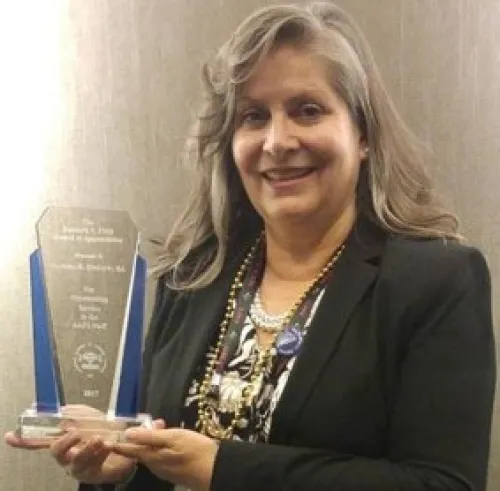
Sandra is a retired 29-year forensic art veteran of the Los Angeles County Sheriff's Department. She managed Forensic Imaging Unit with two forensic artists located at the Homicide Bureau (https://www.linkedin.com/in/sandra-enslow-6803036/).
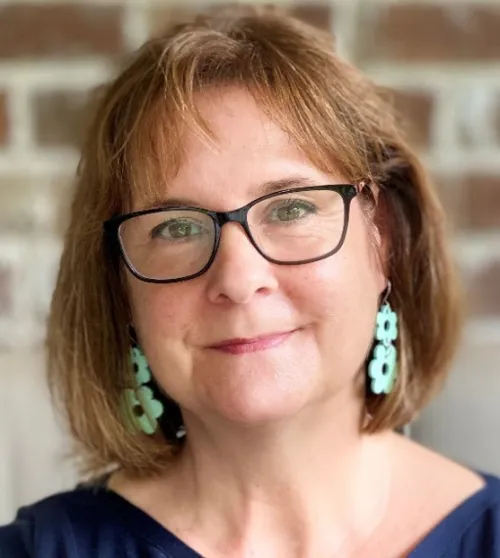
Barbara is a Forensic Artist and Sculptor and specializes in reconstructing faces from the skull and sketching composites. For 19 years she worked in the Forensic Investigation Unit for the Sacramento Police Department in California and became the Police Department's first Forensic Artist. She later branched out as a consultant for Coroner's Offices and is a freelance artist
(https://artandforensics.com/about).
How did your discipline get started?
Sandra: In the early 1800s, this forensic imagery was first utilized by early law enforcement. By the 1850s, this form of forensic information was used especially in the western United States. In 1956, The Los Angeles County Sheriff's Department, the largest Sheriff's Department in the country, established an Art Department that focused on supporting the Criminal Investigation Divisions in the agency. Now separate from the LASD Graphics Unit, the LASD Homicide Bureau houses the Forensic Art Unit. It is one of the longest running forensic units in the country.
Barbara: Police Sketch Artists have been around for a long time. It required someone with knowledge of facial anatomy plus artistic talent (like a portrait artist) to do this work.
Tell me about how you became involved in your field.
Sandra: Sheer accident. I was a graphic designer and commercial illustrator who went to work for the Board of Supervisors, County of Los Angeles. I worked on a project for two Sergeants who were assigned downtown. They saw my figure illustration skills and when I was about to be laid off, helped transfer me to the Sheriff's Department. I was there only two weeks before I attended my first autopsy. I had no idea what I was getting into.
Barbara: I studied Criminal Justice and received my Bachelor of Arts in 1985. I was hired in the Identification Unit at the Sacramento Police Department in California, and they had no one to do composite sketches. I have an art background and knew how to draw a face, so I stepped into that role. I was taught how to use the Identi-kit, which is what the department used. The Identi-kit, invented by Detective Hugh McDonald in 1959, contained overlays with facial features that you placed one on top of the other to create/build a face. Look it up at okstatelibrary (https://www.instagram.com/reel/C_TNAmjPgKb/?hl=en). In 2000, I attended the FBI Academy in Quantico, VA, and was enrolled in their Facial Imaging Program. From them I also learned how to draw a postmortem sketch of a cadaver, how to create a face from the skull, and how to properly conduct an interview.
Was this something you always knew you wanted to do, or did something happen in your life that made you realize what your career path should be?
Sandra: No, this was not what I had planned. But I fell in love with "the hunt" and the special dynamic that forensic art can often bring to the mix. It is not just facial composite drawings of suspects, but much, much more, including postmortem drawings of victims, facial reconstructions from skulls, Video Approximation drawings, video courtroom exhibits, among other aspects. We are in collaboration with detectives to assist them in their goal of solving the case.
Barbara: When I was 16 years old, I went to Paris, France, saw all the street portrait artists, and wanted to be like them. While attending college, I looked into being a police sketch artist and soon realized I had to expand my expertise to get inside a police department. Voila, I studied Forensics. I drew sketches for the police through the 1990s without any training because there was a waiting list to get into the FBI Academy.
What made you focus on your specialty?
Sandra: I was in the right place at the right time. Eventually, I became the manager of the unit and helped forge a new generation by hiring young people who trained under me. Technology also has played a big part. Rather than making "Forensic Art a Lost Art," it has intensified what we do. Computer programs and AI cannot compete — though they have bravely tried.
Barbara: I was the first sketch artist the SPD ever had, and the detectives were so happy to have this extra help. Word got out and my Chief asked me to do sketches for other police agencies. My police department sent me to Manchester, England, to study the European method for reconstructing faces, to the National Center for Missing & Exploited Children in Virginia to learn how to age children and adults, and to the University of Knoxville in Tennessee to learn human anthropology. In Knoxville, I learned about DMORT, which is under the National Disaster Medical System (federal government). A few of the anthropologists were on a DMORT team, and I followed in their footsteps and joined DMORT Region-9. I soon began helping the local coroner's office with their unidentified cases. Gradually I moved beyond being a sketch artist and worked a lot of cases for different medical examiners.
Was there a certification process within your discipline when you entered?
Sandra: Yes, there are many groups and individuals who hang out a sign promising to "certify" you. Within the IAI, I tried to introduce the idea of an Organization of Scientific Committees for Forensic Science (OSAC). I was shut down fast. After 13 years of IAI membership, I left, disgusted, in 2011. That was also the year that I attended my first Academy meeting in Chicago.
Barbara: Yes, through the International Association for Identification (IAI). I got certified, and the police department raised my salary too.
When did you become a member of AAFS?
Sandra: I joined in 2012, sponsored by Barry Fisher, and I never looked back. I should have come sooner.
Barbara: I joined in 2008.
Was forensic art a discipline when you joined the AAFS?
Sandra: Yes, Betty Pat Gatliff, Catyana Falsetti, and Dr. Daniel Marion, among others, were here. You will notice that I have changed the name with this question. Forensic "Artistry" is an older name that is no longer used.
Barbara: Forensic Artists were under the General Section.
Was education / training a priority in the Academy at that time?
Sandra: No. We are not even on the radar.
Barbara: It was always important.
How did your education help you succeed in your field?
Sandra: By having the training that I received from my BA, the training at the FBI Academy in Quantico (1999), and then the real time work and training in the field from the LASD Forensic Trainer, I grew with confidence and experience in my craft, interview skills, and interpersonal dealings. (Experience counts for everything in this business. You can take all the classes you want — sooner or later, you must get in the water and swim.) You never know what is coming through that door, and I depended on that training!
Barbara: It showed me that the field of Forensic Art was not limited. It can be used in so many different ways. I had no idea I could do so much when I first started out as a sketch artist. Attending so many different schools and conferences, and learning from experts in other forensic disciplines (forensic odontologists, anthropologists, and entomologists) gave me an amazing career I never knew existed.
How did your education help you succeed in the AAFS?
Sandra: Before coming to the county, I worked in the private sector in corporate environments. I managed art departments and creative people. This, too, was an education, and I applied it to the AAFS. I understood that I must participate and get involved for the good of the whole. It was a good experience for me.
Barbara: I joined at the endorsement of one of my Facial Reconstruction instructors, Betty Pat Gatliff, who was a member of the AAFS.
How did you realize that forensic art/training and education should be a discipline/priority within AAFS?
Sandra: It already was a discipline, albeit ignored. That the discipline needed help to get an OSAC was clear and along with my colleague, Catyana Falsetti, we made every effort possible to do that. I saw that a Forensic Art OSAC could solve many problems. Would-be forensic artists are at a loss as to where to start and find they must spend a good deal of money to take classes — that don't lead to a job — as are detectives and LE agencies, who have been collateral damage all this time. What constitutes a Forensic Artist? Anybody that can draw? All kinds of fly-by-nights soak agencies for work that is substandard and questionable. Many of these agencies are small, on tight budgets and in high crime areas.
Barbara: After I attended my first AAFS conference in 2009, I realized that Forensic Artists had very little attention within the General Section.
How did forensic art get off the ground?
Sandra: Necessity is the mother of invention. Your question was answered above, with the first question. Mrs. Falsetti and I started a Forensic Artist Discussion group in the LinkedIn App in the early 2000s, approximately. This was well attended, with many people signing in to it. Many forensic artists were not getting answers but, instead, were getting prodded to "take another course."
Barbara: Betty Pat was instrumental in calling attention to the Forensic Art discipline. She worked on cases with anthropologists and advertised courses she taught in the AAFS newsletter too.
Were you faced with support/opposition? If opposition, how did you overcome that? (How did AAFS help?)
Sandra: Everyone was happy that I presented or put up a poster. But when I attempted to put on a workshop, I was told they didn't think it would be well attended. That was it. No discussion. So . . . I didn't overcome it.
Barbara: I was supported from the beginning.
What are the advantages and disadvantages of your specialty developing into its own AAFS section?
Sandra: No advantage. It is well situated in the General Section. What is needed is more FAs to join and attend the AAFS. Some FAs don't have degrees but many do.
Barbara: It would be nice to see that happen! There are not a lot of Forensic Artists, which is why we get combined with other smaller disciplines — General Section.
How did your work on discipline-irrelevant AAFS committees affect your progress through the AAFS?
Sandra: It slowed me down, but it also exposed me to wonderful opportunities and to meeting new people.
Barbara: I have not worked on any Section or Academy committees.
What are your thoughts on how to keep advancing the field?
Sandra: The discipline needs an OSAC. It may help if people could come in as an Associate and go no further. But my race is run. My last meeting was in Anaheim, 2020. I retired in 2021 and then moved out of California to Utah. I have not been active, but my unit at the Homicide Bureau, LASD is still working. I have immense pride in the unit and the people I left behind and in the LASD.
Barbara: Networking. Forge relationships with experts in other disciplines. At conferences, attend classes outside of your expertise. Join organizations. Stay in the know.
How has your specialty helped the AAFS?
Sandra: Yes, through our efforts on LinkedIn, we have made the FA community aware of the Academy. The FA Discussion Group is no longer up, but it served its purpose.
Barbara: I don't know if it has, honestly.
How has the AAFS helped your specialty?
Sandra: It has helped me, not so much my specialty. I was happy to make Fellow. I am still a member but have not had time to attend, though I want to. If there is anything else I can help you with, please advise.
Barbara: I don't know if it has, honestly.
The views and opinions expressed in the articles contained in the Academy News are those of the identified authors and do not necessarily reflect the official policy or position of the Academy.